"Are the signals you're feeding back into Google and Meta tied to contract starts and production?"
I've been asking marketing leaders at orthodontic DSOs that exact question for months. More often than not, the answer is no.
And that one answer explains almost everything frustrating about your paid media right now. You're spending real money on Google and Meta. Leads are coming in. Your CEO keeps asking whether any of it is actually producing patients, and you can't give a confident answer because all Google and Meta report back to you are leads. And not all leads turn into contracts.
That break between a lead generated and a patient signed is the most expensive blind spot in orthodontic marketing. Here's where it comes from, what it's costing you, and why almost nobody in this space has closed it.
Your weekly report looks fine. So why are your chairs empty?
You know the report. Your agency sends it every Monday: cost per lead, number of calls, number of form fills, maybe a tidy trend line. It looks good. Volume is up. Lead costs held steady.
But something's off. Calls aren't turning into patients. People book, but then they don't show.
I've talked to teams who have doctors calling leads back by hand before consults, just to keep show rates up. This is inefficient, and it's not something that would be necessary if Google and Meta weren't sending soft leads.
They know they have a problem. But they don't know why or what to do about it.
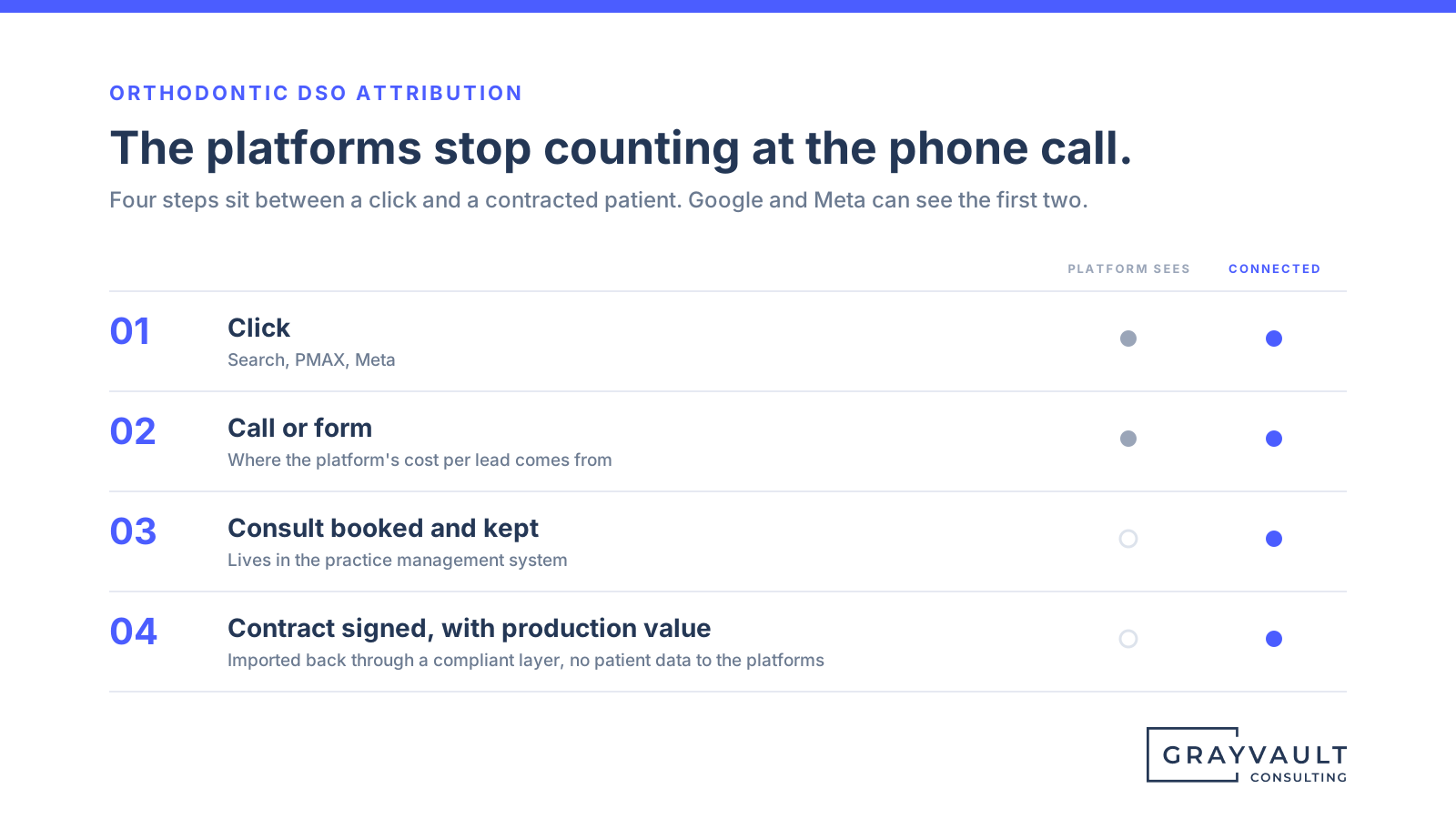
Google and Meta stop tracking at the phone call
The root cause of all of this is simple: Google and Meta are built to track a phone call or a form fill. And that's it. They can't follow the person who called to see whether they showed up, sat in the chair, and started treatment.
The algorithm can only learn from what you feed it. Whatever you defined as a "conversion" when you set up the account, usually a phone call or a form fill, is what it chases. It finds you more of those. More calls. More form fills.
But a phone call from someone who dials in from three states away, asks one question, and never books teaches Google the exact same lesson as a call from someone who signs a $6,000 contract and starts treatment. To the platform, the two are identical. Each one counts as a single conversion. Only one of those leads made you money. The other just wasted your time.
That's why your lead volume looks healthy, your lead costs look fine, nothing on the report flashes red, but lead quality is on a downward spiral. Google has been getting better and better at the wrong job.
What all of this costs you
This is one of the top reasons we see ortho DSO groups underperform on paid media, and the damage goes well past the wasted spend.
Start with what the junk volume does to the leads that are good. Your front desk has a fixed amount of attention, and every call from a tire-kicker three states away is a call your team is tied up on while a ready-to-sign patient hits voicemail. This is where your intake process quietly loses patients. The wrong signal doesn't just buy you bad leads, it also buries the good ones under them.
The pattern shows up downstream, too. Lower-intent inquiries are the ones that ghost before the consult, no-show for consultations, and balk at a full case, so down payments shrink, and average case values slide.
Why this is harder to solve in orthodontics than almost anywhere else
Orthodontics makes this harder than almost any other business, for a few reasons.
The window is long. Months can pass between a patient's first inquiry and a signed contract. By the time someone finally signs, the click that brought them in is ancient history.
At the same time, the value of a single contract is high. An orthodontic case is worth thousands of dollars over a year or more of treatment, not a single transaction. That changes the math on what you can afford to spend to win one patient, and it makes knowing what you actually pay for a patient who signs far more useful than knowing what you pay for a phone call.
But your ad platforms aren't tracking that outcome, and that's not a problem you or your agency can solve by flipping a switch in your ad settings. The signed contract, the production value, none of that is visible to Google or Meta. That data stays locked inside your practice management software. Connecting it to the original ad click takes an integration that ties the two records together. But almost nobody does that.
Most agencies stop at the form fill. Most tracking tools stop at the phone call. The contract record, the one number your CFO actually cares about, sits on the far side of a wall the marketing stack was never built to cross.
What changes when you track all the way to the chair
The solution I recommend is to stop feeding Google calls and start feeding it contracts.
When a patient signs, that contract, with its real dollar value attached, goes back to Google and Meta as the conversion that matters. Now the platform isn't chasing whoever picks up the phone. It's chasing whoever actually signs. It learns the real profile of a patient who contracts, the keywords they searched, the device they used, the time of day, the audience, and goes to find more people like them.
It changes how you bid, too. You can tell Google that a patient who signed a $7,000 contract is worth more than one who signed a $3,500 contract, and watch it move spend toward the higher-value cases on its own. This ties directly to how you set CPA and ROAS goals against real patient value.
And it finally gives you the number your CEO and CFO have been asking for all along: your cost per contracted patient. Not cost per lead, but what you actually pay for a patient who signs and starts treatment, broken down by campaign and by location.
This isn't theory. We helped build exactly this at Smile Doctors, the largest orthodontic DSO in the United States, across 500-plus locations, and drove 24% year-over-year production growth doing it. If it works at 500 locations, it works at five. Here's how we connect ad clicks to contracted patients and production, step by step.
The practices that move first win
For years, there was no way to do this. The contract sat in one system, the ad platforms sat in another, and no one connected the dots between them. This isn't necessarily anyone's fault, there just hasn't been a way to solve it.
There is now. You can connect every dollar of ad spend to the patients who actually sign and the production value they generate. But most orthodontic groups still don't have this capability because nobody has built it for them yet. If you want to see where your own setup stands, our DSO paid media approach is built around exactly this problem.
We can. When you're ready to draw a straight line between your ad spend and the production value it generates, let's talk. Schedule a free consultation with me here.