We Tested Google's AI Max on a $100K/Month Account. Here's What Happened.
A real AI Max experiment on a high-spend ecommerce account, with the full control-vs-experiment data. Conversion value came in about 13% lower and the result was inconclusive. Here is what we learned and when AI Max might actually help.
Craig Graham
•
August 25, 2026
Every few months a new Google Ads feature arrives wrapped in the same promise: turn it on and the machine will find incremental performance you couldn't find yourself. AI Max, Google's AI-driven expansion of Search targeting and creative, is the current version of that promise. So we tested it properly on a real account, ran it as a controlled experiment, and let the data decide.
Here's the result up front: it was inconclusive, and on the metric that matters most to this client, revenue, it trended slightly negative. That's not a headline that sells a course, but it's the truth, and the reason it happened is more useful than any hot take about whether AI Max is good or bad.
The account and the hypothesis
This is a high-spend ecommerce account in the automotive accessories space, running roughly $100K per month in Google Ads alone across PMax, Search, Shopping, and Demand Gen. We also manage Meta, Bing/Microsoft, and ChatGPT Ads for the client, and support the broader marketing strategy, so this test ran inside a mature, well-structured account.
Our pre-test hypothesis was straightforward: AI Max should produce incremental conversions and conversion value, ideally at the same cost, and possibly at a higher one. In other words, we expected it to find revenue we weren't already capturing. We set the experiment up on one of the higher-spending non-brand Search campaigns and split it as a standard control-versus-experiment test.
The results
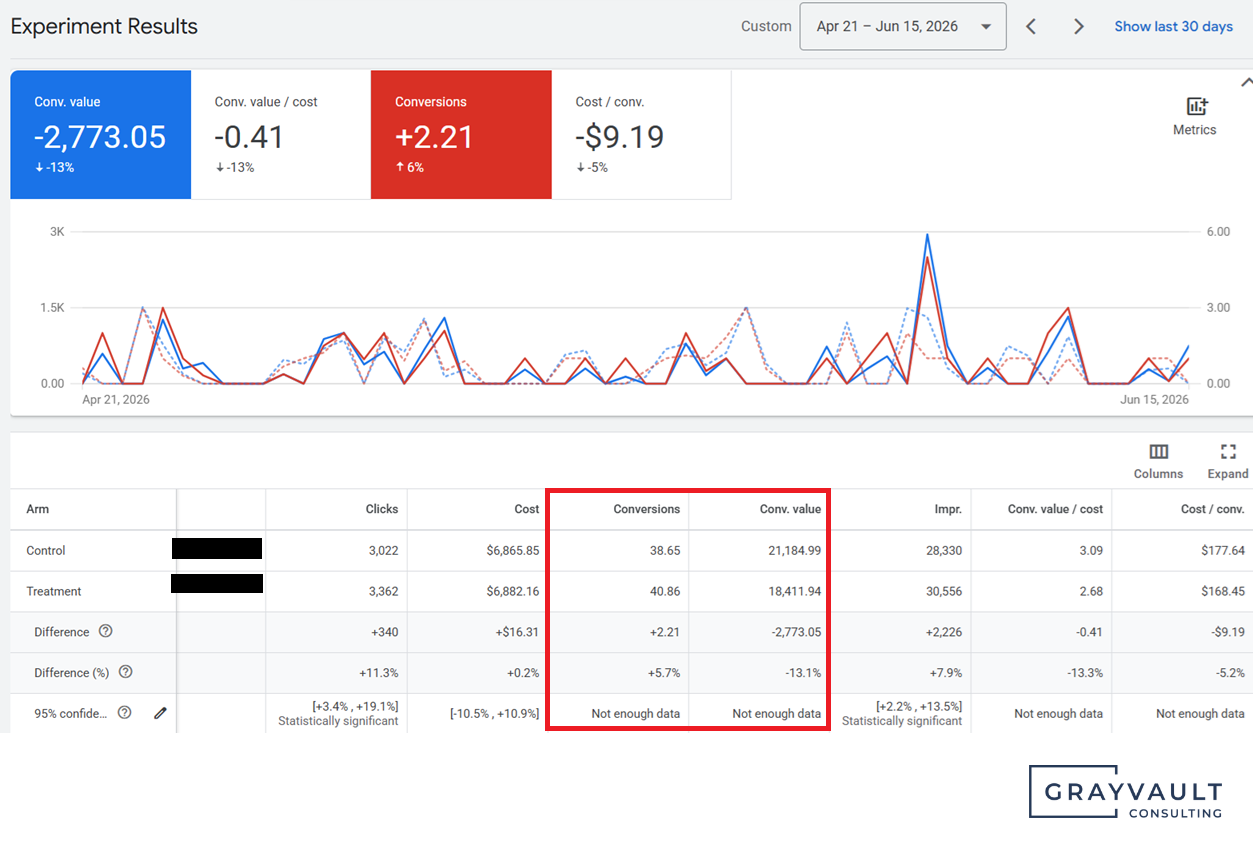
The experiment ran for roughly eight weeks, from April 20 to June 15, 2026. Here is how the two arms compared over the full window:
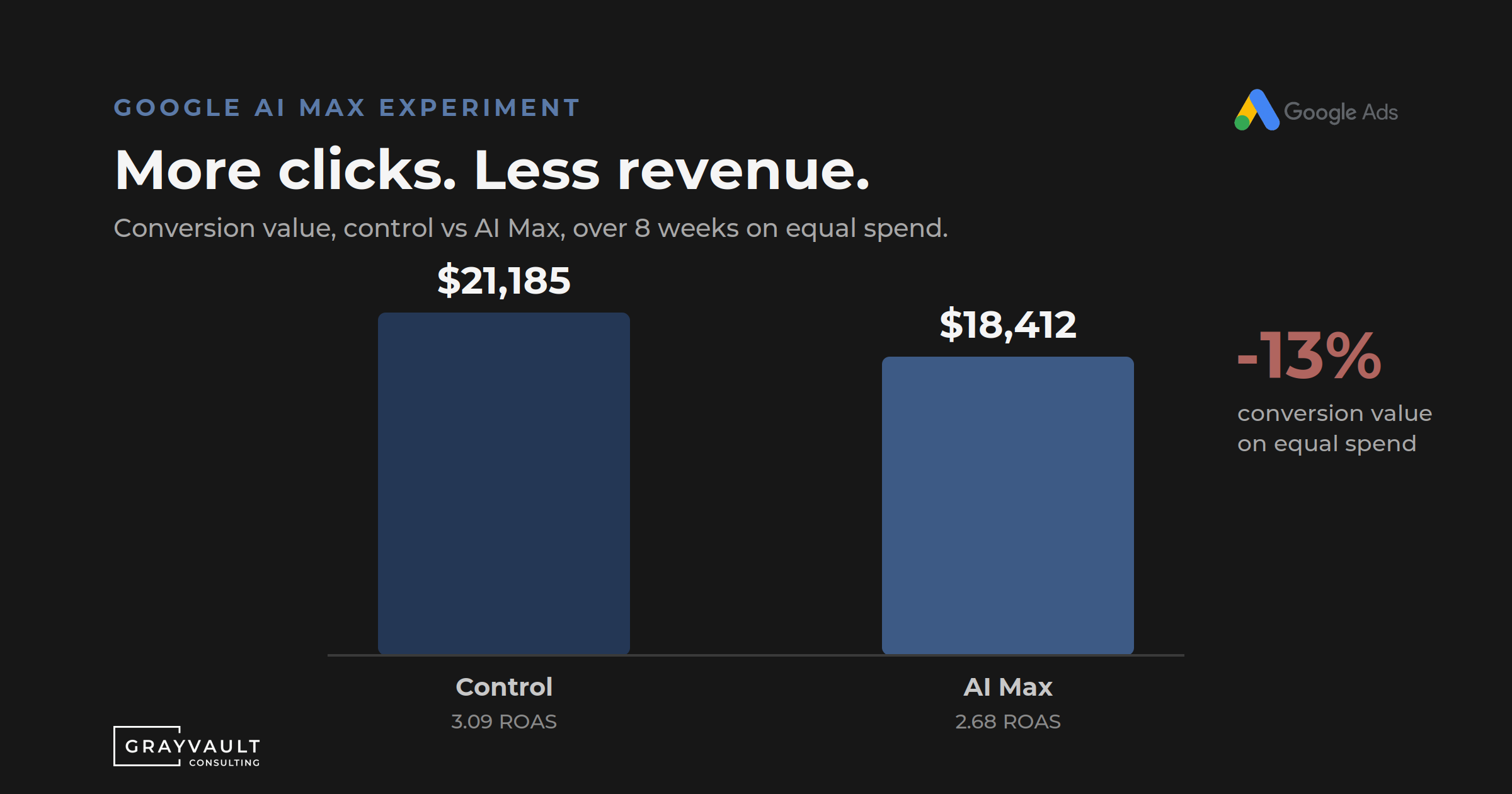
On essentially identical spend, the AI Max arm generated about 13% less conversion value. It did produce more clicks, up 11.3%, and more impressions, up 7.9%, both statistically significant. Conversions were nominally higher too, up 5.7%, but that is a difference of about two conversions and average order value was down, so on volume the two arms were effectively flat. The clearer story is in revenue quality: more traffic came in, and it converted at a lower value.
Why we called it inconclusive rather than a failure
This is the part many case studies skip, so it's worth being precise. The experiment did not reach statistical significance on its goal metrics, conversion value and conversions. Google's own experiment tool never flagged the result as conclusive; "not enough data" was the status on the metrics that mattered right through to the end.
What we did have was a directional signal that stayed consistent across every weekly snapshot: the control arm held a revenue-quality advantage the whole way through, even though that advantage never crossed the significance threshold. So we had no statistical proof that AI Max hurt performance, and no evidence it helped. Faced with that, the responsible call was not to roll it out. We left the control running as the only live version and kept the account on standard Search.
That distinction matters. "Inconclusive, trending slightly negative" is a genuinely different finding from "AI Max failed," and treating the two as the same is how bad decisions get made in paid media.
Why we think it played out this way
The most likely explanation is account maturity. This account has robust keyword targeting and years of accumulated negative keywords, which means the search term territory is already well covered. AI Max works by expanding into new queries and match territory, so in an account that has already mapped most of its relevant space, there simply isn't much incremental ground left to capture. The extra clicks it found were real, but they skewed toward lower-value queries, which is exactly what you'd expect when the high-intent terms are already being captured by existing campaigns.
We've seen the same pattern before when testing broad match on mature accounts, so this wasn't a surprise. It's the recurring lesson that automation tends to help most where there's slack in the account and least where there isn't.
One honest caveat on our own test: while this was one of the higher-spending Search campaigns in the account, a larger budget or a longer window may have produced enough data to point more confidently toward incrementality, or the lack of it. We're not claiming this is the final word on AI Max. We're reporting one well-run test on one real account.
When AI Max is probably worth testing
None of this means AI Max is a bad product. It means it's a tool, and tools have conditions where they work. Based on this test and our broader experience, AI Max has the most upside on newer or thinner accounts, accounts with limited keyword coverage, or accounts sitting on untapped query space where there's real territory left to expand into. In those situations, the same expansion mechanism that found nothing new here could find quite a lot.
The accounts where we'd be most cautious are the mature, tightly built ones, where the incremental room is small and the risk is that expansion pulls in lower-value traffic, which is roughly what we saw.
The actual takeaway
The lesson isn't "AI Max works" or "AI Max doesn't." It's that you don't find out by reading a LinkedIn thread or turning a feature on across every account because it's the thing everyone's talking about. You find out by testing it, in a controlled way, against the metric that actually pays your bills, and being willing to accept an inconclusive answer when that's what the data gives you.
That discipline is the same reason we're careful about setting CPA and ROAS goals around real profit rather than platform-reported proxies, and why a structured PPC audit is usually where we start on any new account: you have to know what's already working before you can judge whether a new feature added anything. It is the same reason how we measure results across a mixed channel set matters more than any single platform's verdict on itself.
If you'd like a second set of eyes on whether a feature like AI Max is worth testing in your account, or on where your paid media is leaving revenue on the table, that's the kind of conversation our paid media audit is built for. No pressure, just a clear read on your account. You can book a discovery call with me here.
.svg)



.svg)
.png)
.png)


.svg)

.svg)